
Last updated: November 7, 2026
CoolTone vs CoolSculpting comes down to the tissue you want to address: CoolTone uses magnetic muscle stimulation to strengthen and tone the abdomen, buttocks, and thighs, while CoolSculpting uses cooling to reduce targeted fat bulges. Neither treatment replaces weight loss, and the right choice depends on whether your concern is muscle definition, localized fat, or something else.
What is the difference between CoolTone and CoolSculpting?
At CosmetiCare, our CoolTone treatment focuses on muscle toning. The U.S. Food and Drug Administration’s CoolTone device documentation identifies abdominal muscle strengthening and toning of the buttocks and thighs as its intended uses.
The distinction is easiest to see side by side:
| Question | CoolTone | CoolSculpting |
|---|---|---|
| What does it target? | Muscle in the abdomen, buttocks, or thighs | Localized fat beneath the skin, such as a suitable bulge on the abdomen, love handles, outer thighs, or under the chin; treatment depends on the fat pocket and applicator fit |
| What is the goal? | Greater muscle strength and definition | Reduction of a suitable fat bulge |
| Does it replace weight loss? | No | No |
Does CoolTone remove fat like CoolSculpting?
No. CoolTone is a muscle-conditioning treatment, not a primary fat-reduction treatment. More visible muscle definition may be a goal, but that is different from using cooling to reduce a pocket of fat.
How do CoolTone and CoolSculpting work?
CoolTone generates an electromagnetic field that triggers repeated muscle contractions, helping strengthen and tone the treated muscles. CoolSculpting uses controlled cooling to affect fat cells in a targeted bulge. These different mechanisms explain why fat freezing and muscle toning address different goals, even when the area of concern is the same.
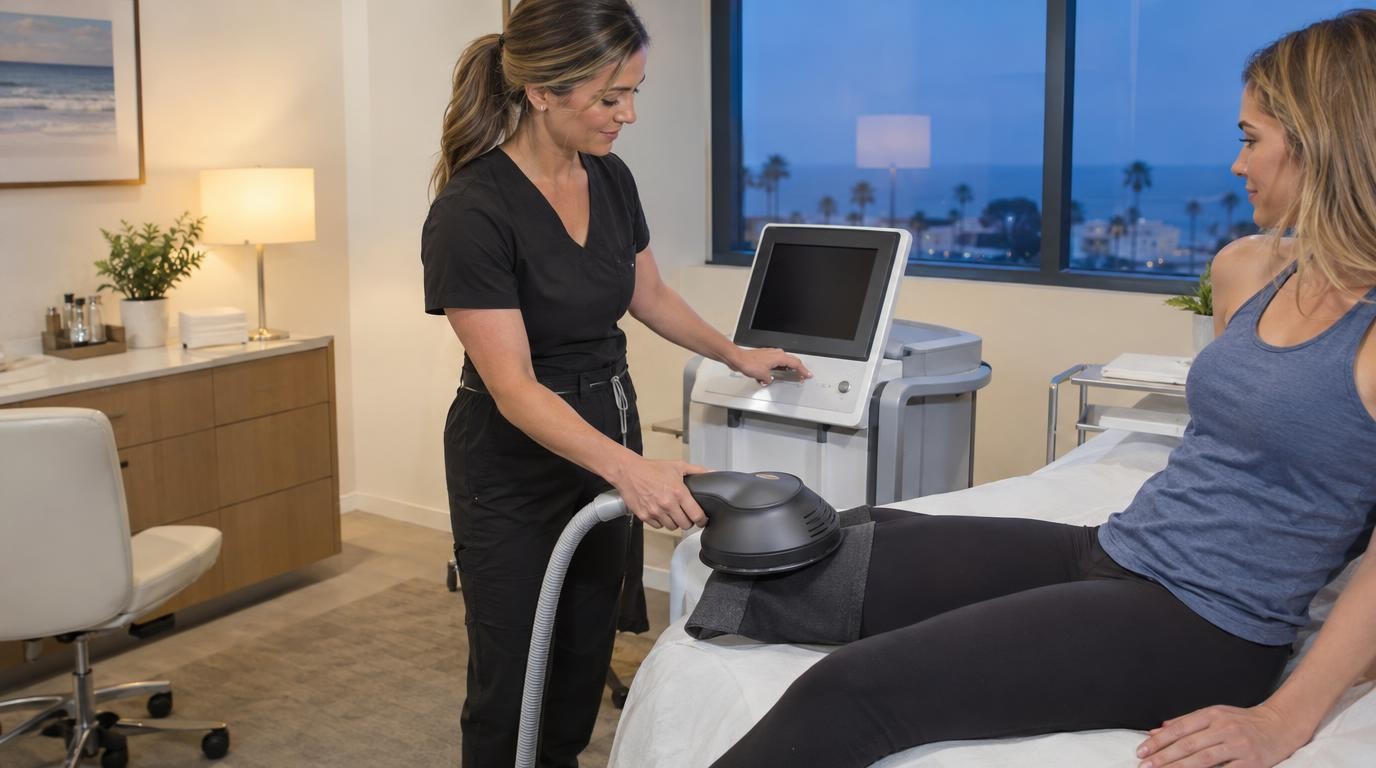
During CoolTone treatment, a provider controls the muscle stimulation through the device. With fat freezing, a suction applicator draws a suitable fatty bulge into its opening and cools the fat layer beneath the skin.
Does CoolTone use fat freezing?
No. CoolTone uses magnetic muscle stimulation, not cooling. In a small clinical tissue study of a single abdominal treatment, researchers found no evidence of subcutaneous fat-cell injury after electromagnetic muscle stimulation, while cryolipolysis samples showed fat-cell injury.
Which treatment matches your body-contouring goal?
Consider CoolTone when your goal is stronger, more defined muscle in the abdomen, buttocks, or thighs. Consider CoolSculpting when your main concern is a localized, pinchable fat bulge. If loose skin is the concern, neither treatment should be assumed to solve it. We can assess skin laxity separately and discuss whether an option we offer, such as Thermage or a tummy tuck, suits your anatomy and goals.
Is CoolSculpting worth it if you want to reduce stubborn fat?
CoolSculpting may fit that goal when the fat deposit is localized and expectations are modest. An article on the American Society of Plastic Surgeons’ website describes CoolSculpting as an option for focal pockets of fat, not weight loss, and notes that results are not immediate. If you want more than a mild-to-moderate contour change, ask us whether liposuction, a surgical option we offer, better matches your goal; CoolSculpting does not replace it. Our overview of CoolSculpting for nonsurgical fat reduction offers more background on that approach.
Can CoolTone and CoolSculpting be part of the same plan?
Yes, when someone has both a suitable fat bulge and a muscle-toning goal, the treatments can address different layers. In a 50-person feasibility study of abdominal contouring, the group receiving both treatments had the greatest average reduction in abdominal circumference and the highest average improvement rating from independent physicians reviewing photographs, compared with the groups receiving either treatment alone. As a feasibility study, it does not mean everyone needs both treatments; the appropriate choice and sequence depend on individual assessment.
Who may be a good candidate for CoolTone or CoolSculpting?
At CosmetiCare, a potential CoolTone candidate is an adult in generally good health who is relatively close to their goal weight, exercises regularly, and wants to tone the abdomen, thighs, or buttocks. A suitable CoolSculpting candidate generally has a localized fat deposit, minimal skin laxity, and realistic expectations; health history also matters.
The American Society of Plastic Surgeons’ guidance on nonsurgical fat reduction says patients who are pregnant or breastfeeding should not undergo cryolipolysis. Cleveland Clinic’s CoolSculpting screening guidance also lists an unrepaired hernia, an active infection, and extensive treatment-area scarring that prevents the applicator from fitting as reasons CoolSculpting may not be suitable. An active infection needs assessment and may mean postponing treatment. Cleveland Clinic also says CoolSculpting may not be the best choice for someone with a BMI over 25 or under 18.5. Those are its screening ranges, not universal cutoffs; your clinician should assess your weight and health history individually.
Can CoolTone replace your regular workouts?
No. We recommend CoolTone as a supplement to a regular exercise routine, not a replacement for it. Maintaining an exercise habit also helps set realistic expectations for muscle-toning treatment.
What happens during treatment, and is there downtime?
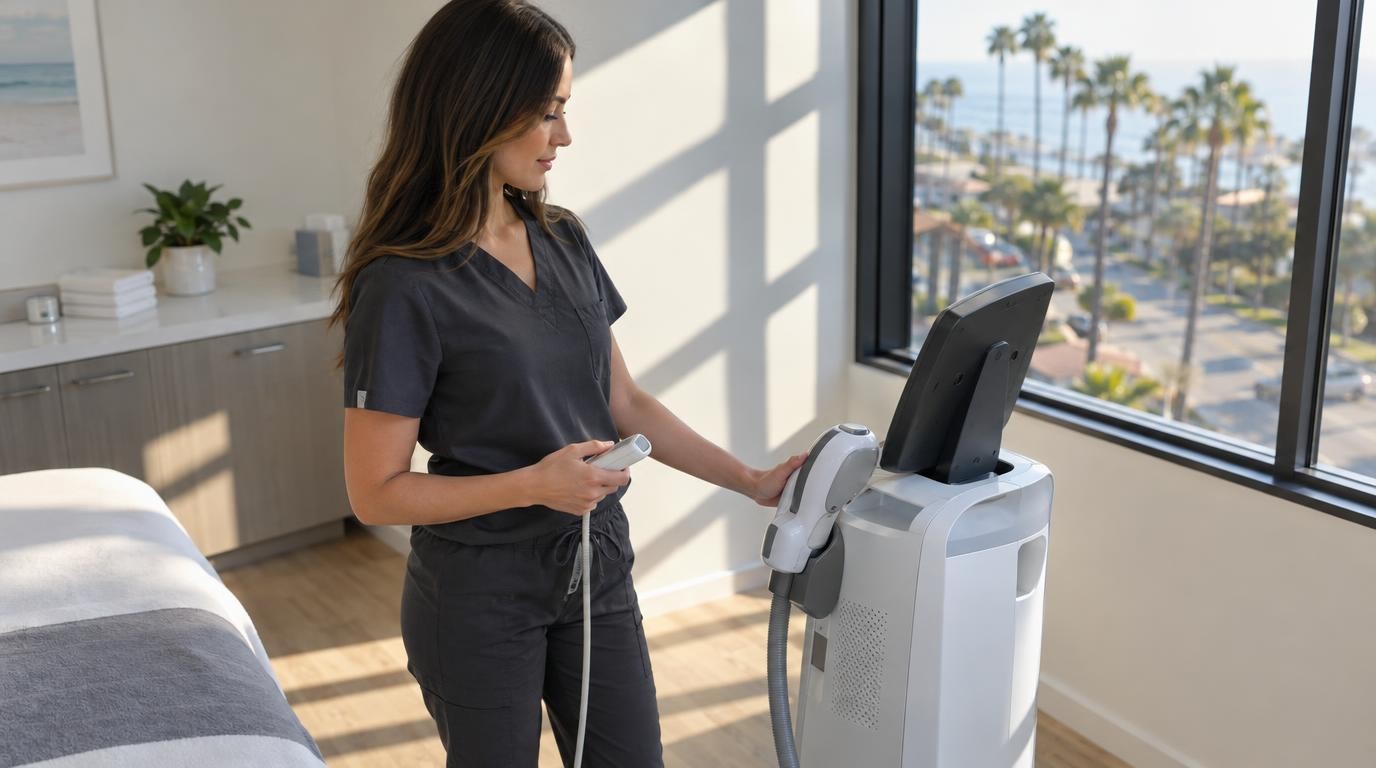
We position the CoolTone applicator over the target area and use electromagnetic energy to produce muscle contractions. There typically is no recovery downtime, so you can generally resume your usual activities afterward. The contractions may feel like light muscle spasms and can be mildly uncomfortable, but significant pain is not expected. Before your first session at CosmetiCare, we discuss your goals and whether treatment suits you. Anesthesia typically is not needed.
Our CoolTone appointment takes around 30 to 60 minutes; the device can deliver up to 30 minutes of muscle stimulation. We monitor and adjust treatment using the device’s control screen.
How many CoolTone sessions are typically recommended?
We typically recommend four CoolTone sessions over two weeks. Your treatment schedule may differ based on your goals and assessment.
How much downtime does CoolSculpting require?
Most people can resume normal activities immediately after CoolSculpting, although temporary symptoms in the treated area can occur.
When can you expect CoolTone results?
Full CoolTone results typically start to become visible about two to four weeks after the final session, though individual results vary.
Does CoolTone tighten skin?
No. CoolTone’s purpose is muscle toning and strengthening. If loose or hanging skin is what bothers you, muscle stimulation alone should not be presented as a skin-tightening solution.
How often might CoolTone maintenance be needed?
We suggest a CoolTone maintenance session every three to six months. That is our typical recommendation, not a guarantee that results will last for a particular period or that everyone will need the same schedule.
What side effects and risks should you discuss before treatment?
CoolTone may cause muscle soreness for a day or two, while CoolSculpting can cause temporary redness, bruising, discomfort, or numbness in the treated area. A prospective abdominal electromagnetic-muscle-stimulation study of 16 participants reported one mild device- and/or procedure-related event of menstrual-cycle irregularity; that single report cannot establish how often this occurs with CoolTone.
Fat freezing also has a rare but important risk called paradoxical adipose hyperplasia, in which the treated area becomes persistently larger. Cleveland Clinic’s cryolipolysis guidance says men and people of Hispanic ethnicity are more likely to experience it; that information does not establish an individual’s probability. We review your health history and device-specific risks before either procedure.
Why is my belly bigger after fat freezing?
Temporary swelling can make a recently treated area look larger. Persistent or increasing fullness could signal paradoxical adipose hyperplasia, a rare complication of cryolipolysis in which fat cells enlarge after treatment. A persistent bulge should be evaluated rather than assumed to be a normal stage of results.
Who should not have CoolTone?
At CosmetiCare, patients who are pregnant or nursing do not meet our CoolTone candidacy criteria. Other health factors and device-specific contraindications also need review; a person who is unsuitable for CoolTone is not automatically suitable for fat freezing. Discuss your health history and individual risks with your own licensed clinician before treatment. Seek prompt medical attention for severe or worsening pain, marked skin discoloration, blistering, or signs of infection after a procedure.
Frequently Asked Questions
When will I see CoolSculpting results?
CoolSculpting results may become noticeable as early as three weeks after treatment, with the most dramatic changes often seen one to three months afterward. Results vary by person and treatment area. A follow-up after changes have developed lets us assess the treated area rather than judge the result immediately after treatment.
What does CoolSculpting feel like during treatment?
CoolSculpting can feel like pulling and intense cold at first. The applicator draws the fatty bulge inward before cooling it; tingling, stinging, aching, or cramping are also possible. These sensations typically lessen as the area becomes numb during treatment. Tell your provider if discomfort concerns you.
Can I get CoolSculpting if I have Raynaud’s syndrome?
CoolSculpting may not be appropriate if you have Raynaud’s syndrome or another cold-induced skin condition, such as cold urticaria. Cleveland Clinic identifies these conditions as reasons to avoid the procedure. Do not assume CoolTone is automatically suitable instead.
Does CoolTone improve core strength or just muscle appearance?
CoolTone targets muscle tone, and abdominal electromagnetic muscle stimulation may improve functional strength as well as appearance. In the prospective study noted above, adults received eight abdominal treatments over four weeks; plank and curl-up performance improved from baseline at one, two, and three months after the final treatment. That schedule differs from our typical CoolTone plan, so the study cannot predict your individual strength gains.
Can fat come back after CoolSculpting?
Fat cells damaged or destroyed by cryolipolysis are permanently removed, but you can still gain weight afterward. Fat may still be deposited in other areas of the body. CoolSculpting changes a targeted fat bulge; it does not prevent future weight gain or replace habits that support weight maintenance.
How many CoolSculpting sessions will I need?
You may need more than one CoolSculpting session. The number of treatment cycles depends on the area being treated, so there is no single schedule that fits everyone.
What should you ask at a CosmetiCare consultation in Newport Beach?
At your consultation, we can examine the area and review your health history before recommending a treatment plan. Ask what degree of change is realistic, how we would assess your progress, and what might make us recommend waiting or choosing another option. No specific contour change can be promised.
If you are weighing muscle toning against fat reduction, contact CosmetiCare in Newport Beach, California, for a consultation. Our team can assess your concern, explain which of our treatments may fit, and help you make an informed decision without promising a particular result.
This information is general and is not medical advice. Talk to a licensed clinician about your own situation before making a treatment decision.
