
Last updated: November 9, 2026
CoolSculpting for a double chin can reduce a pinchable pocket of fat without surgery, but the expected change is usually a subtle refinement rather than a dramatic new jawline. At CosmetiCare in Newport Beach, our CoolSculpting treatment targets stubborn fat; whether it fits your chin depends on what is causing the fullness.
Can CoolSculpting reduce a double chin without surgery?
Yes. CoolSculpting can reduce localized fat beneath the chin without incisions, although results vary and are generally modest. The FDA’s CoolSculpting clearance documentation, K151179, addresses treatment of submental fat, and a published pivotal study of 60 subjects evaluated chin treatment. Clearance does not guarantee an individual result.
What does FDA clearance for chin treatment mean?
FDA 510(k) clearance means the device was found substantially equivalent to a legally marketed device for reducing submental fat; it is different from FDA approval. The clinical study supplied evidence for that decision. Clearance does not establish how much any particular person’s chin contour will change.
How does CoolMini treat fat beneath the chin?
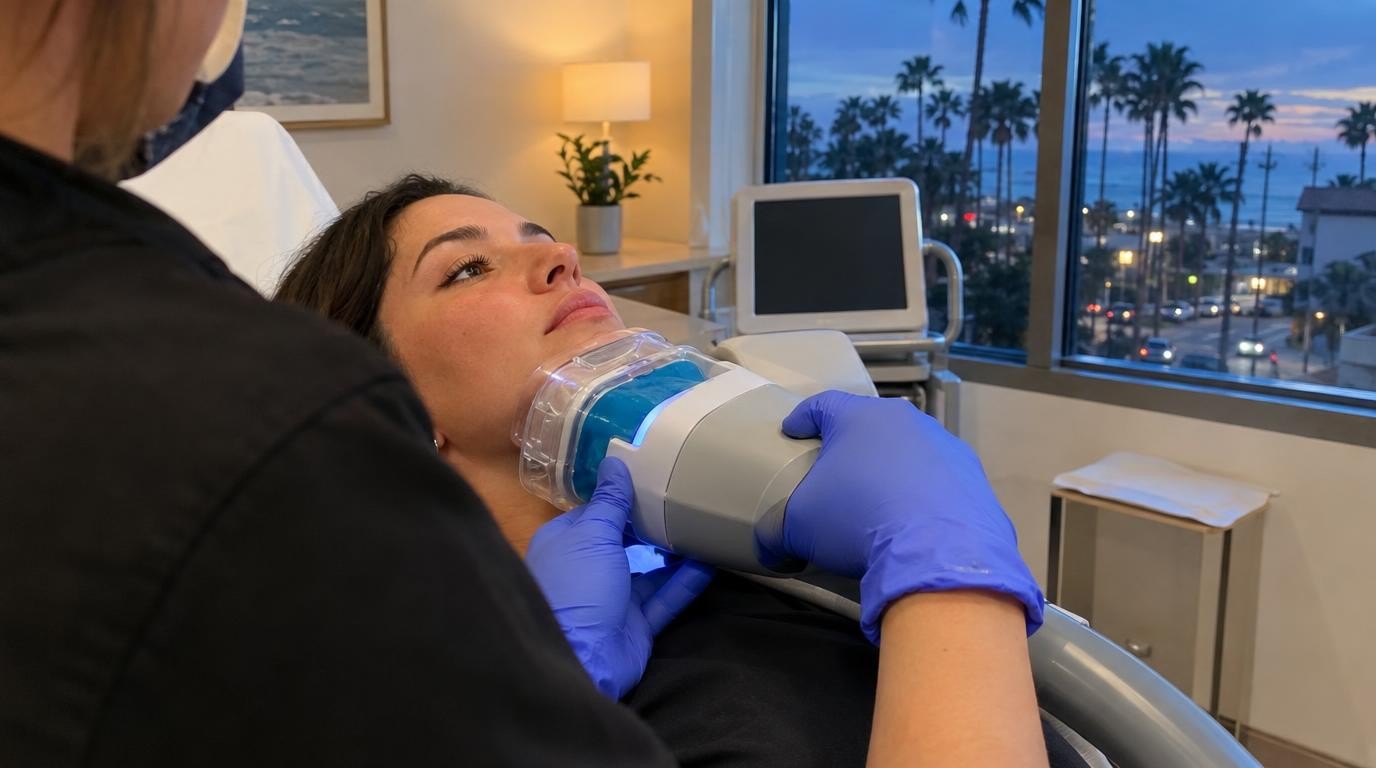
CoolMini is a small applicator used to deliver controlled cooling to a localized pocket of fat beneath the chin. Cooling injures targeted fat cells, which the body gradually clears. In the published pivotal chin study, CoolMini was the research applicator; the study’s settings should not be assumed to be CosmetiCare’s current chin protocol.

An article on the American Society of Plastic Surgeons’ site explains that a vacuum applicator delivers controlled cooling at the skin’s surface to affect localized fat. This is contouring, not removal of skin or a treatment for weight loss.
What did the CoolMini chin study actually measure?
The published pivotal chin study measured whether independent physicians could identify pretreatment photos, changes in fat-layer thickness by ultrasound, patient-reported outcomes, and device- or procedure-related serious adverse events. Researchers delivered one CoolMini cooling cycle per visit and permitted an optional second treatment, as detailed below.
The published pivotal chin study reported the following protocol and findings:
| Measure | What the study reported |
|---|---|
| Participants and treatment | The study treated 60 subjects. Each visit involved a 60-minute cycle at -10 degrees Celsius; an optional second treatment could occur at 6 weeks. |
| Blinded photo review | Three physicians correctly identified pretreatment photographs in 91% of comparisons. |
| Fat-layer measurement | Ultrasound found a mean reduction of 2.0 mm. |
| Subject satisfaction | At 12 weeks after the final treatment, 83% of subjects reported satisfaction. |
The 91% finding measures how often reviewers distinguished before photos from after photos; it is not a patient success rate. The mean ultrasound finding describes the study group, not a promised reduction for an individual chin. The published pivotal chin study reported no device- or procedure-related serious adverse events among its 60 subjects, but a study of that size cannot rule out rare serious complications.
Who is a good candidate for chin CoolSculpting?
A person with a localized, pinchable fat pocket beneath the chin and realistic expectations may be a good candidate for CoolSculpting. Loose skin, prominent neck bands, or jawline anatomy can create fullness that fat reduction alone will not correct. A new or unexplained lump or swelling needs medical assessment rather than an assumed fat-reduction treatment: swollen lymph nodes, displaced submandibular glands, or thyroid enlargement can also affect the appearance of your chin and neck. Significant neck enlargement may prevent proper applicator placement.
Clinical assessment matters because a smaller fat pocket does not necessarily produce tighter skin. An article on the American Society of Plastic Surgeons’ site describes good CoolSculpting candidates as people with localized fat, minimal skin laxity, and expectations of mild to moderate improvement. In practice, that distinction is more useful than judging candidacy from a photo alone.
Cleveland Clinic’s CoolSculpting guidance flags a BMI over 25 or under 18.5 as a reason treatment may not be a good choice. Those are candidacy guidelines, not universal device contraindications; we consider your anatomy and goals rather than BMI alone.
A current dental infection needs clinical review before chin treatment. Tell us about any past facial nerve weakness or paralysis, including Bell’s palsy; an active implanted device, such as a pacemaker, defibrillator, or drug-delivery system; and a bleeding disorder or medication that may increase bruising. Also disclose recent fillers, botulinum toxin (Botox) injections, radiofrequency or laser procedures, or chemical peels in your chin or neck, as well as prior fat reduction, an implant, or surgery in or near the area. These factors were among the FDA chin study’s exclusions, not automatic current device contraindications; we will review your history and current device guidance. Do not stop prescribed medication without consulting the clinician who prescribed it.
Will losing weight get rid of a double chin?
Losing 20 pounds might reduce a double chin, but you cannot count on it to eliminate it. How much changes depends on whether the fullness is mainly fat, loose skin, or the underlying shape of your jaw and neck. CoolSculpting targets localized fat rather than causing weight loss.
What happens at a general CoolSculpting appointment in Newport Beach?
At CosmetiCare, our general CoolSculpting process is:
- We plan the treatment area, apply gel, and position the cooling panels over the targeted fat.
- The device cools the area; you may feel suction as built-in sensors monitor the temperature.
- After the session, you can generally resume your normal activities.
During treatment, you can rest, read, or watch something while the device works. If you are considering treatment beneath your chin, ask us whether we currently offer it and which applicator and protocol we would propose if we do.
How long does a CoolSculpting treatment take?
At CosmetiCare, a CoolSculpting treatment generally takes around one hour. The published CoolMini chin study used a 60-minute cycle, but that research protocol does not establish the duration of every current appointment. Planning, positioning, and any additional areas can affect the time you spend at the clinic.
When will you see chin results, and how many sessions might you need?
At CosmetiCare, changes may become visible in the first few weeks and are generally most noticeable around 2-4 months; for session planning, a Mayo Clinic Press article reports an average of 2 to 3 CoolSculpting treatments per area, although your chin plan may differ. Mayo Clinic Press says treatments are usually repeated within 1 to 3 months. Chin results vary, so neither a fixed number of sessions nor a dramatic jawline change can be promised.
Maintaining a stable weight matters to the appearance of your result. Our guide to waiting between CoolSculpting treatments discusses spacing additional sessions.
How much change should you expect from one chin treatment?
The published pivotal chin study cannot give us a reliable one-session success rate or promise a particular amount of change from one treatment because it allowed an optional second treatment. At 12 weeks after their final treatment, 77% of subjects in that published pivotal chin study reported visible fat reduction. The change visible after one treatment depends on the starting fat pocket, skin quality, and individual response.
What is recovery like after chin CoolSculpting?
Most CosmetiCare patients can return to normal activities after CoolSculpting, although the treated area may feel temporarily red, sore, or tingly. At CosmetiCare, these symptoms typically resolve within a week. Recovery is not identical for everyone, and persistent, worsening, or unexpected symptoms warrant clinical assessment.
Minor bruising or numbness can also occur after cryolipolysis, as an article on the American Society of Plastic Surgeons’ site notes. Little expected downtime does not mean that the chin will look or feel entirely unchanged immediately after treatment.
What are the risks, and who should not get CoolSculpting?
Temporary redness, soreness, tingling, numbness, and bruising are possible after CoolSculpting. A rare but important complication is paradoxical adipose hyperplasia, in which treated fat enlarges rather than shrinks; its exact frequency is uncertain. We review your medical history, chin tissue, and current device guidance before recommending treatment.
Cleveland Clinic describes paradoxical adipose hyperplasia as a firm enlargement in the treated area rather than an expected short-term sensation.
What disqualifies you from CoolSculpting?
The FDA’s chin study excluded people with cryoglobulinemia, cold urticaria, paroxysmal cold hemoglobinuria, Raynaud’s disease, or another condition that limits skin blood flow in response to cold. Those research exclusions are not a complete list of current device contraindications; we must review your condition against the current device instructions. An active infection or unsuitable skin and tissue may also rule out or delay treatment. Seek urgent care for trouble breathing or swallowing; promptly report spreading redness, fever, severe or worsening pain, or a firm enlarging area after treatment.
Which is better, Kybella or CoolSculpting?
Neither treatment is universally better for a double chin. CoolSculpting cools a localized fat pocket without injections, while Kybella uses injections to reduce submental fat. The better fit depends on the fat pocket, skin and jawline anatomy, preferences about injections, expected recovery, and the degree of contour change sought.
The American Board of Cosmetic Surgery’s overview of nonsurgical fat reduction distinguishes cryolipolysis from injectable deoxycholic acid, the treatment used in Kybella. CosmetiCare offers both options; our guide to Kybella injections for double-chin fat explains the injectable approach.
The American Board of Cosmetic Surgery gives these typical treatment and recovery details:
| Option | How it treats fat | Typical treatment and recovery |
|---|---|---|
| CoolSculpting | Controlled cooling without injections | Treatment takes 35 to 60 minutes per area; normal activities can usually resume immediately. Temporary swelling, numbness, redness, or tingling can occur. |
| Kybella | Deoxycholic acid injections beneath the chin | Injections take about 20 minutes; the typical patient needs 2 to 4 treatments spaced 1 month apart. Most return to full activity within 2 days. Temporary swelling, numbness, redness, or bruising can occur. Rare effects include facial weakness or prolonged numbness; these usually resolve on their own. |
When might another approach fit a double chin better?
When loose skin or jawline structure is the main concern, reducing fat by either method may not deliver the desired change. For someone seeking a more substantial reduction in chin or lower-face fat, a surgical option may be worth comparing. CosmetiCare also discusses lower-face liposuction for the jawline and chin.
What should you ask at a Newport Beach consultation?
Ask what is causing your chin fullness and what change treatment can realistically achieve. At a CosmetiCare consultation in Newport Beach, the discussion can also cover the proposed applicator, treatment plan, recovery, and when to reassess results. Comparing CoolSculpting with Kybella or a surgical option helps align the plan with your goal.
- Is the fullness primarily pinchable fat, loose skin, or jawline anatomy?
- Which applicator and treatment plan would you propose for my chin?
- What degree of change is realistic, and when should we reassess it?
- Would Kybella or a surgical option better address the feature I want to change?
Frequently Asked Questions
Are CoolSculpting results for a double chin permanent?
The fat cells destroyed by CoolSculpting do not return, but your chin’s appearance can still change if you gain weight. Cleveland Clinic explains that the body eliminates treated fat cells. At CosmetiCare, we recommend maintaining a healthy lifestyle to help preserve your contour.
Can CoolSculpting treat fat under the jawline, too?
Yes, CoolSculpting can treat fat under the jawline as well as under the chin. A Mayo Clinic Press article notes that both areas are FDA-cleared treatment sites. A small applicator can target a localized fat pocket, but reducing fat will not change your jawbone or tighten loose skin.
Does CoolSculpting under the chin require anesthesia?
No, CoolSculpting typically does not require anesthesia because it is a noninvasive cooling treatment, not surgery. An article on the American Society of Plastic Surgeons’ site notes that sessions require no anesthetic. You may initially feel suction and intense cold. At CosmetiCare, you can rest or read during treatment and usually resume normal activities afterward.
Does freezing chin fat raise your cholesterol?
No. An article on Cleveland Clinic’s site explains that the body processes treated fat cells through normal fat-cell turnover without raising blood cholesterol or other blood lipids. CoolSculpting does not treat high cholesterol.
How long after chin filler or Botox can you get CoolSculpting?
There is no universal waiting period established by the chin study. The FDA’s clearance documentation reports that researchers excluded people who had dermal fillers or botulinum toxin injections in the neck or chin within the previous 6 months. That was a research eligibility rule, not a required waiting period for everyone.
Can a double chin get bigger months after CoolSculpting?
Yes, a rare complication called paradoxical adipose hyperplasia can cause a firm, usually painless enlargement of treated fat rather than a reduction. An article on Cleveland Clinic’s site reports that these masses can appear 3 to 9 months after treatment. A new, firm, enlarging area under your chin warrants prompt clinical assessment.
Can you get CoolSculpting on your chin while pregnant?
No, CoolSculpting is not recommended during pregnancy. An article on Cleveland Clinic’s site identifies pregnancy or an expected pregnancy as reasons to avoid treatment.
What is the next step if you are considering chin treatment?
The next step is to identify what is creating the fullness before choosing a fat-reduction method. CoolSculpting may offer a subtle, nonsurgical improvement when a treatable fat pocket is the main issue; other approaches may fit different anatomy or goals. Contact CosmetiCare for an in-person consultation in Newport Beach to discuss your options without assuming eligibility or a particular result.
This information is general and is not medical advice. Talk to a licensed clinician about your own situation before making a treatment decision.
